Natural Polyphenols Oleuropein and Hydroxytyrosol in Therapeutics: Potentials Against Cancer, Inflammation, Oxidative Stress, and Diabetes
- Authors
-
-
Faryal Shams
Faculty of Natural Sciences, Islamia College University Peshawar, 25120, Pakistan.Author -
Muhammad Ibrahim
Department of Precision Medicine, Universita degli Studi della Campania, 80138, Italy.Author -
Shana Perrella
Department of Precision Medicine, Universita degli Studi della Campania, 80138, Italy.Author -
Sumaira Saeed
Department of Precision Medicine, Universita degli Studi della Campania, 80138, Italy.Author -
Fabiana Monfrecola
Department of Precision Medicine, Universita degli Studi della Campania, 80138, Italy.Author -
Carmen Lenti
Department of Precision Medicine, Universita degli Studi della Campania, 80138, Italy.Author -
Immad Khan
Institute of Chemical Sciences, University of Peshawar, 25120, Pakistan.Author -
Faiq Firdous
Center for Omics Sciences, Islamia College Peshawar University, 25120 Pakistan.Author
-
- Keywords:
- Oleuropein, Hydroxytyrosol, Antioxidant, Anticancer, Anti-inflammatory, Antidiabetic
- Abstract
-
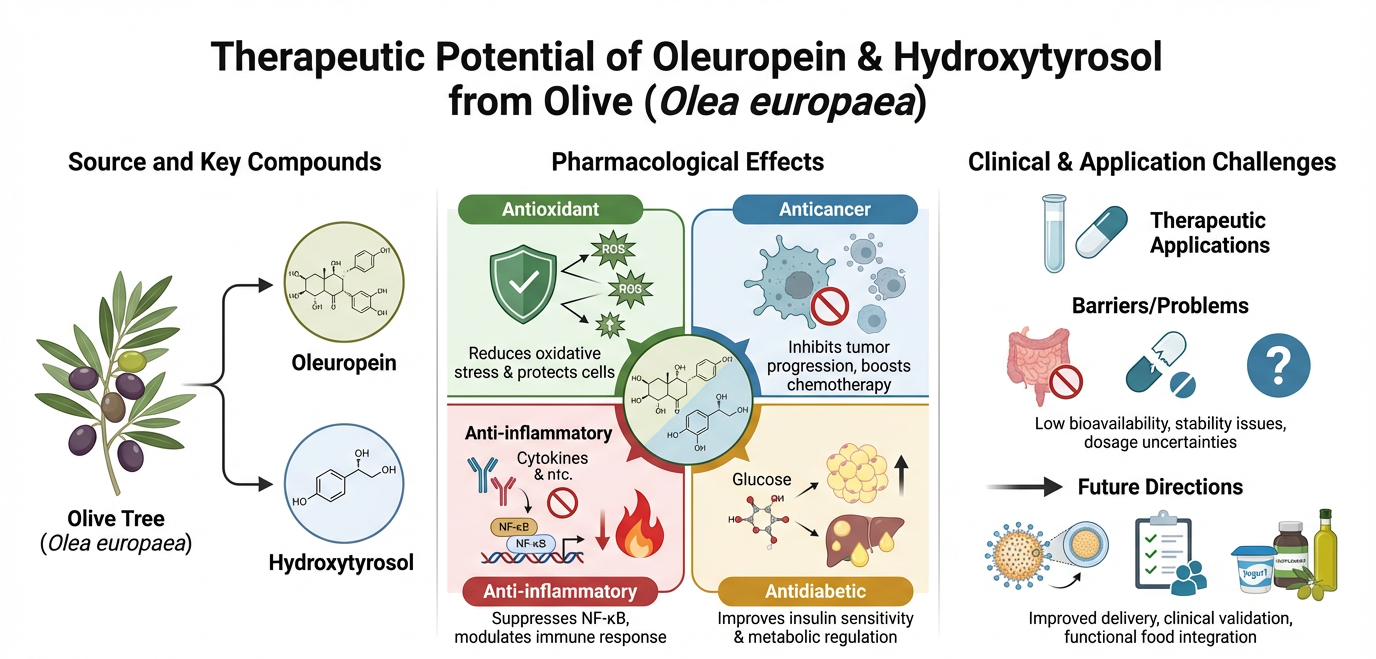
Oleuropein and hydroxytyrosol, two major polyphenolic compounds extracted from the olive tree (Olea europaea), have attracted significant scientific interest due to their strong pharmacological properties, including anticancer, antioxidant, anti-inflammatory, and antidiabetic effects. These compounds play a crucial role in modulating oxidative stress, neutralizing free radicals, and protecting against cellular damage, thereby contributing to neuroprotection, cardiovascular health, and metabolic regulation. Their anticancer potential has been widely demonstrated through their ability to inhibit tumor progression, induce apoptosis, and demonstrate the ability to enhance the efficacy of chemotherapy in various tumor models, including breast and hepatocellular carcinoma. Additionally, their anti-inflammatory activity is attributed to the regulation of cytokines, suppression of NF-κB signaling, and modulation of immune responses, which could be beneficial in managing chronic inflammatory and autoimmune diseases. Moreover, their role in diabetes management has been extensively studied, demonstrating their ability to improve insulin sensitivity and regulate glucose metabolism, and reduce lipid accumulation in hepatic and adipose tissues, thus preventing metabolic complications. Despite extensive preclinical evidence supporting the therapeutic benefits of these compounds, their clinical translation remains challenging due to issues related to bioavailability, stability, and optimal dosage. Future research should focus on improving their pharmacokinetic properties, developing advanced drug delivery systems, and carrying out extensive clinical trials to confirm their safety and effectiveness in humans. The integration of these compounds into functional foods, nutraceuticals, and pharmaceutical formulations holds immense promise for preventive and therapeutic applications, potentially offering natural alternatives to conventional therapeutic agents for managing metabolic, inflammatory, and degenerative diseases.
- References
- Cover Image
-
- Downloads
- Published
- 2026-05-13
- Issue
- Early Access
- Section
- Articles
- License
-

This work is licensed under a Creative Commons Attribution-NonCommercial-NoDerivatives 4.0 International License.

How to Cite
Similar Articles
- Faruk Arodiya, Nahid Malik, Chirag Makvana, Kokila Parmar, Green Synthesis of Copper Nanoparticles with Adhatoda Vasica: Antibacterial and Antioxidant Study , Journal of Chemistry and Environment: Vol. 4 No. 2 (December 2025)
- Uzair Khan, Zeshan Ahmad, Sara Ali, Zama Jan, Murad Khan, Humayun Khan, Sayed Nauman Shah, Synthesis, characterization and Bioactivity Evaluation of Heteroleptic Zinc(II) Complexes: Antioxidant and α-Amylase Inhibition Studies , Journal of Chemistry and Environment: Early Access
- Bao Hui, Xu Guangqua, Liu Xiang, Selhaba Ayesha, Simulation Study of Groundwater Polluted by Landfill Leachate in Subsidence Areas , Journal of Chemistry and Environment: Vol. 4 No. 1 (June 2025)
You may also start an advanced similarity search for this article.